For students majoring or minoring in Spanish at Rockhurst University, this year brings unexpected change.
Madeline Critchfield, Ph.D., one of only two full-time professors in the program, is leaving the university for personal reasons, placing the department at a turning point.
Leslie Merced, Ph.D., associate professor of Spanish and chair of the Department of Modern Languages and Literatures, said the program will remain stable during the transition.
“Next year, the program will stay status quo,” Merced said.
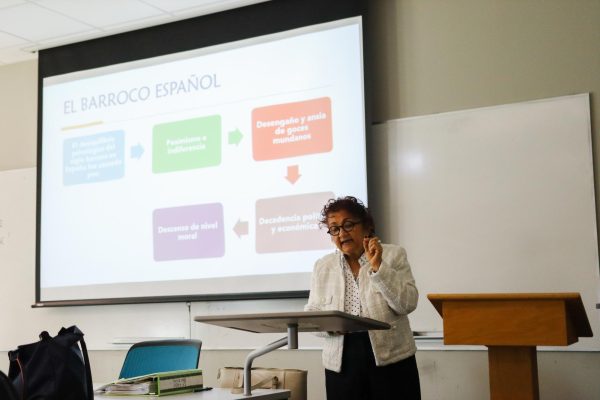
Merced will take over the courses Critchfield previously taught while the university searches for a replacement. The department plans to hire a new faculty member with a doctorate in Spanish linguistics, with the goal of having someone in place by fall 2027 or spring 2028.
“We believe that the support of the Rockhurst University administration for the Modern Languages Department and our popular undergraduate and graduate Medical Spanish programs, as well as our upcoming Legal Spanish program, will result in a replacement in the near future for the Spanish vacancy we have at the moment,” Merced said.
Critchfield served as assistant professor of Spanish, contributing to the department’s offerings in Spanish linguistics and upper-division coursework.
Merced has taught at Rockhurst since 2011. She earned a doctorate in Spanish Peninsular literature from the University of Illinois Urbana-Champaign and completed graduate work in German.
Before coming to Rockhurst, she developed a German program at Benedictine College, creating a minor and preparing students for study abroad opportunities in Heidelberg, Germany. At Rockhurst, she has also served in leadership roles, including associate chair for multiple departments and director of Women, Gender and Sexuality Studies.
Rockhurst continues to offer a bachelor’s degree in Spanish and a Spanish minor. The curriculum includes advanced conversation and composition, linguistics, cultural studies and a senior capstone.
Due to the staffing transition, the senior capstone course will temporarily shift from a traditional classroom format to independent studies. Merced said she prefers the traditional classroom environment for its collaborative dynamic but emphasized that the change is short term.
The department currently has about 20 to 30 Spanish majors, along with numerous minors.
One of the program’s distinguishing features is its focus on Spanish for the professions. Rockhurst offers a Medical Spanish minor, an undergraduate certificate in Medical Spanish and an online graduate certificate in Medical Spanish.
The programs operate through a badge system, in which four courses equal a minor and five complete an undergraduate certificate. The graduate certificate attracts working professionals such as nurses, biology graduates and medical students from across the country.
“Our greatest asset in that program is the fact that all those classes are online,” Merced said. “We are getting interest from all parts of the U.S.”
The department is also developing a Legal Spanish certificate and minor, with plans to expand it to the graduate level.
While Spanish remains the core of Rockhurst’s modern languages program, other language offerings have narrowed.
The German minor has been eliminated because of staffing limitations. Although Merced has a background in German, she said she is needed full time in Spanish to sustain the program.
The French minor remains in the catalog, but French courses have not been regularly offered because enrollment has not met minimum requirements.
“We’ve had two or three students interested in French, and that is not enough to fill a class,” Merced said, noting that at least four students are required to run a course.
Despite the transition, the department is pursuing expansion. Rockhurst is exploring collaboration with other Jesuit institutions, including Spring Hill College in Mobile, Alabama. Potential partnerships could allow shared online coursework and new study abroad opportunities, including a Rome-based program that may introduce Italian language study or culturally immersive experiences.
Merced said modern language education extends beyond memorizing vocabulary and verb conjugations.
“Modern languages are learned by doing tasks in the classroom,” she said. “The practicality of speaking a foreign language is based on what you can do with it.”
She added that students pursuing careers in health care should know Spanish to communicate effectively with Spanish-speaking patients, build trust and understand cultural practices.
“We have designed our Medical Spanish courses to incorporate all aspects of Spanish communication, the Spanish technical language of medicine and the medical cultural practices that relate to Latin American patients,” Merced said.
While the loss of a faculty member is significant for a small department, Merced said the Spanish program is maintaining its structure while preparing for a new hire and continuing to expand professional pathways tied to medicine and law.
For students deciding whether to enroll in Spanish, the department’s message is clear: the program continues to offer skills that extend far beyond the classroom and into students’ professional futures.